Will AI actually cite your content?
Paste your article and get a Citability Score — a plain-English read on whether ChatGPT, Perplexity, Gemini and Google's AI are likely to quote you. Then get a specific, copy-paste fix-list to make it citable. Nothing is uploaded.
This grader runs entirely in your browser. Your content is never sent to a server, stored, or shared.
This tool grades your writing. To check a live page's technical AI-search health — crawlability, schema, meta and on-page signals — use its companion.
How it works
You paste your content
Drop in an article, page, or draft — optionally the question it should answer. Nothing is uploaded; the text stays in your browser.
We grade it, live
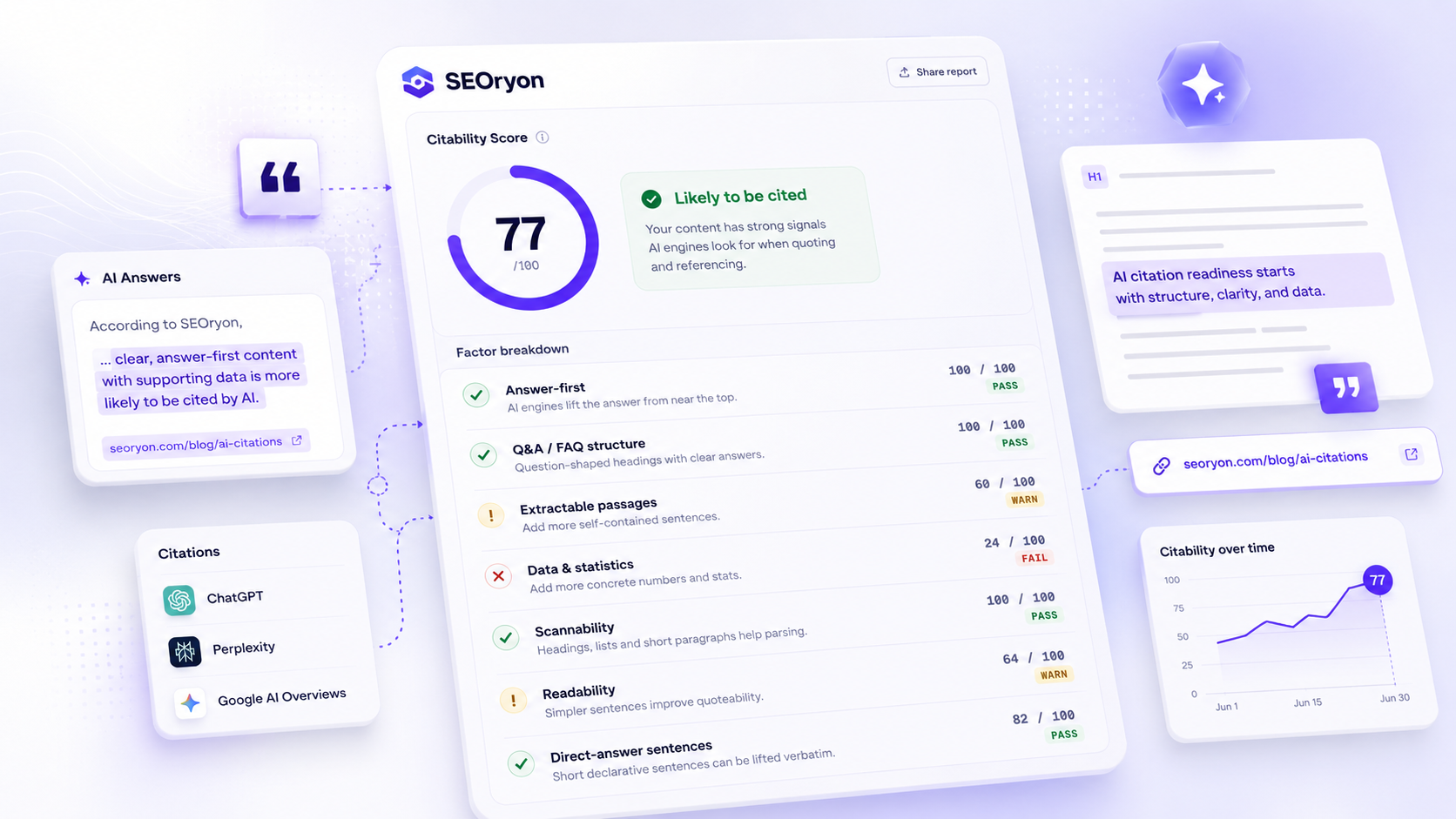
A transparent, rule-based check scores the factors AI engines favour when they pick what to quote — answer-first phrasing, Q&A structure, data, scannability, clarity.
You get a fix-list
A prioritized, copy-paste list of concrete rewrites — the biggest gaps first — so you know exactly what to change to become more citable.
A heuristic, shown in the open.
This is not a guarantee of citation — no tool can promise that. It's a transparent estimate based on the structural content factors that research ties to being cited by AI engines. Studies of generative-engine and answer-engine optimization find that a handful of these factors explain most of the difference between content that gets quoted and content that gets skipped. We score each one and weight them into a single 0–100 grade.
Answer-first
AI engines lift the answer from near the top. We check whether your content leads with a direct answer instead of a long wind-up — and, if you gave a target question, whether it's answered early.
Q&A / FAQ structure
Question-shaped headings with self-contained answers are cited far more often. We detect question headings and whether each is followed by a clean, standalone answer.
Extractable passages & data
Quotable, self-contained sentences and concrete numbers and stats give an engine something to cite. Vague, context-dependent prose gives it nothing to lift.
Scannability & clarity
Clear headings, lists and short declarative sentences help. Readability is scored with a standard formula (English-tuned; for DE/FR we fall back to a language-agnostic length measure and say so).
The weights are documented in the tool's source and shown per factor in your result. Factor selection follows the public findings behind generative-engine optimization (GEO) and answer-engine optimization (AEO) — the same rules used by open-source auditors like Auriti-Labs/geo-optimizer and Canonry/aeo-audit. We reimplemented the rules in our own code; we round every score so it never fakes precision.
The grade shows the gap. SEOryon writes content that's already citable.
This grader tells you what to fix. SEOryon does it for you — it writes content that's structured to be cited by AI from the first draft: answer-first, Q&A-shaped, backed with data, and clean to scan. It reads real search and AI-citation signals, decides what to publish, writes it, and tracks where you get cited across Google, ChatGPT, Perplexity and Gemini.
Start your 3-day free trial →3-day free trial · 3 published articles · 1 in-depth LLM/GEO audit · Cancel in two clicks.
Citable by default
Every article ships answer-first, Q&A-structured and data-backed — the shape AI engines quote — without you rewriting it.
Agency-scale, not agency-price
One agent runs the whole research-to-publish loop, so you get the output of a content team from €39/month.
You see where you're cited
It tracks your mentions across Google, ChatGPT, Perplexity and Gemini — so the grade becomes a scoreboard.
Questions, answered
Is the Citability Score a guarantee my content will be cited?
No — and any tool that claims to guarantee AI citation is bluffing. The score is a heuristic estimate based on the structural factors research ties to being cited (answer-first phrasing, Q&A structure, extractable passages, data, scannability, clarity). It tells you how well your writing is shaped to be quoted; whether an engine actually quotes it also depends on your topic, authority, and competition.
How is this different from score.seoryon.com?
They're companions. score.seoryon.com checks a live URL's technical AI-search health — crawlability, meta tags, schema, on-page signals. This tool grades the writing itself — is the prose structured and phrased to be quoted. One is the page layer, one is the content layer. Use both.
What exactly does it check?
Seven content factors: whether you answer up front, Q&A / FAQ structure, whether passages are self-contained and extractable, statistical / data density, heading and list scannability, readability, and the presence of short direct-answer sentences. Each gets a pass / warn / fail with a one-line reason, and every failing factor becomes a fix in your list.
Does it send my content anywhere?
No. There is no server, no API, no upload. The scoring runs as plain JavaScript in your browser, and your text never leaves the page. The only thing stored is your language choice, kept locally in your browser.
Does it work for German and French content?
Yes. The structural checks (answer-first, question headings, self-contained passages, data density, scannability) are language-agnostic. Readability uses an English-tuned formula for English and a language-agnostic length measure for German and French — we flag which one was used in your result so nothing is hidden.
Why does the same text always get the same score?
Because the scoring is deterministic rules, not an AI model. The same content always produces the same grade and the same fix-list — so you can edit, re-paste, and watch the score move as you improve it.